AI assistant
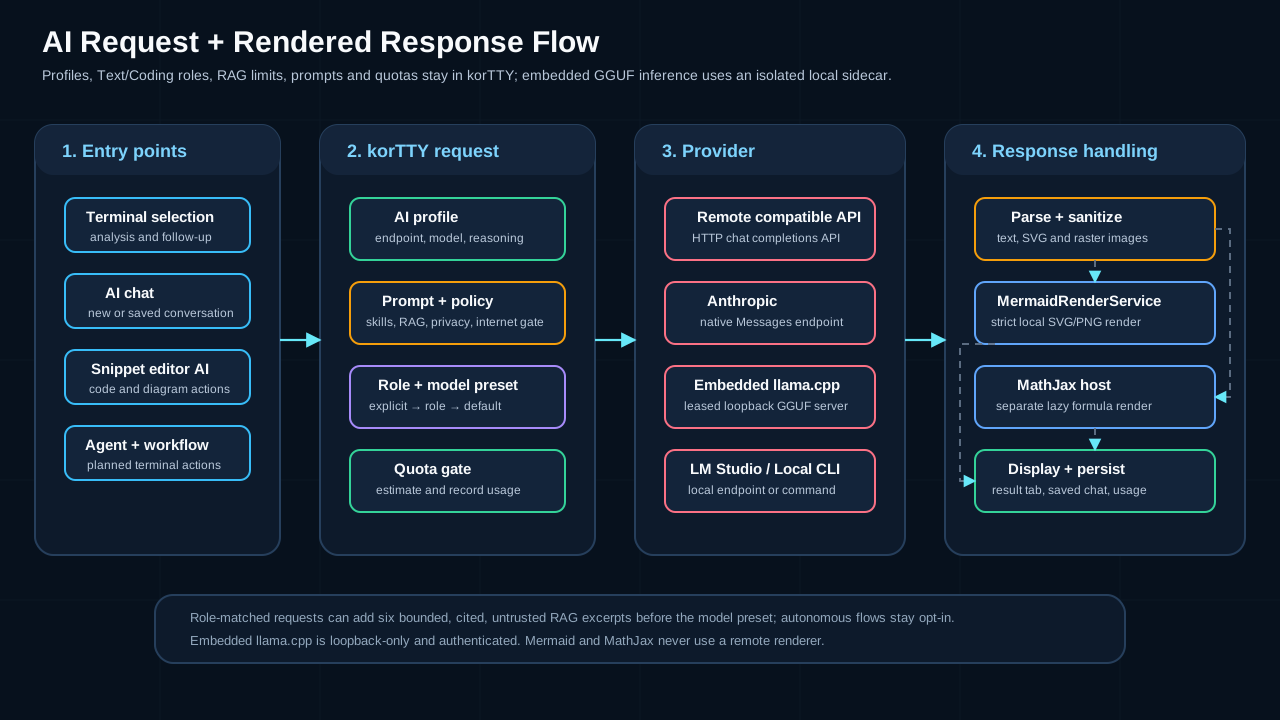
KorTTY can analyze selected terminal text with an OpenAI-compatible AI endpoint, an integrated local llama.cpp model, or a configured local CLI and open the answer in a temporary AI result tab. You can also start agent-style workflows to automate SSH tasks or get plans reviewed before implementation.
When Configuration > Prevent System Sleep is enabled on macOS or Windows, korTTY keeps the computer awake while an AI API, local-model, web-tool, or local AI CLI request is waiting for a result. The assertion is released after the last concurrent AI request finishes; if no terminal is connected and no future or running Scheduler job exists, the computer may then sleep normally. Display sleep remains available.
Data Security
Selected terminal text is transmitted to the configured AI service for analysis. That text can contain sensitive information such as credentials, hostnames, file paths, stack traces, or other operational details. For sensitive data, use an integrated local GGUF model or another endpoint you trust. Embedded inference uses an authenticated loopback-only server; remote providers receive the reviewed request over the network. If you provide an API Key, korTTY stores it encrypted with your master password.
Setup
- Open Edit > Global Settings.
- Go to AI.
- Create one or more AI profiles in Settings > AI or AI > AI Manager > Profiles. Choose HTTP API, Local CLI, or Integrated llama.cpp as the connection mode.
- For HTTP profiles, enter an API URL, model, and optional encrypted API key. For an embedded profile, select an installed GGUF model; korTTY supplies the private endpoint and temporary key. Use AI Manager > Local Models first when no GGUF is installed.
- Optionally configure Prompt optimization, Max characters, Tokenizer, Token limit, warning thresholds, token reset cycle, supported Reasoning effort, and Internet access per profile. korTTY exposes reasoning choices based on the configured endpoint and model; LM Studio's exact native capability metadata takes precedence over compatibility probes so a silently converted effort is not shown as supported. Profiles without a supported explicit reasoning mode keep provider-default behavior.
- Optionally set an AI request timeout in minutes. korTTY does not time out AI requests on its own, so a long task such as the snippet editor's Full code analysis runs until the model answers. The value on the Profiles page applies to every profile; Timeout for this profile overrides it for a single profile, and 0 there means that profile never times out. See AI settings.
- Click Test AI Connection.
- Optionally choose a Default profile, then assign separate Text/translation and Coding roles under AI Manager > Local AI. An empty role uses the default profile.
- Optionally configure the default language for AI-generated text inside code comments and program output, enable the extra instructions field for snippet AI actions, and set how many alternative solutions the snippet editor should request.
- Optionally configure the terminal-agent input-history size (default 20, range 5–100), the agent command name, case-insensitive command matching, execution target, prompt-hook usage, per-run setup dialog, debug/runtime visibility, and activity-panel preferences for AI Agent and AI Planning.
- Optionally disable the confirmation dialog for Summarize and Solve Problem if you want a faster workflow. Ask always opens the prompt dialog.
AI Profile Setup Wizard
A guided wizard creates AI profiles with support for both local and cloud-based language models.
To open the wizard:
- Settings > AI, click Add Profile or Edit an existing profile.
- Tools > AI Manager > Profiles, click Add.
The wizard guides you through:
- Connection Type - Choose local LM Studio or a cloud provider.
- LM Studio Setup - If local: pick a loaded LM Studio model from the list or use Auto mode.
- Cloud Provider Setup - If cloud: select the provider (Anthropic Claude API, OpenAI, or other OpenAI-compatible endpoint).
- API Details - Enter API Key and select or enter the Model name — the model list is pre-filled with common models for the chosen provider, and Load models merges the endpoint's live model list on top. Optionally configure Reasoning effort (if the provider/model supports extended thinking).
- Profile Name - Enter a display name for the profile (e.g., "Claude Opus", "Local LM Studio").
Native Anthropic (Claude) API support is included alongside existing OpenAI-compatible endpoints.
For fully integrated GGUF inference, use the separate AI Manager > Local Models > Setup assistant. It checks hardware, recommends Text/Coding/embedding models, reviews license and exact size, verifies the immutable download, creates an embedded profile, assigns the selected role, and runs a real local chat or embedding function test. See Local models with llama.cpp.
Model selection
The model selector in Settings > AI and Tools > AI Manager > Profiles is editable:
- For known cloud providers the dropdown is pre-filled with common model names for the configured endpoint, so a concrete model can be chosen without an API key. The refresh button next to the selector merges the endpoint's live
/v1/modelslist on top when the API key is valid. - Choosing a listed model stores it as the manual selection.
- Typing a model name stores it as the manual selection so any OpenAI-compatible endpoint works.
- Auto is offered only for local LM Studio endpoints, where korTTY can actually detect the loaded model. Cloud profiles need a concrete model; if none is selected, requests stop with an explicit "select a specific AI model" error.
- An Integrated llama.cpp profile lists installed model IDs from
~/.kortty/llm/models.xml; it does not use the HTTP URL or manual cloud-model field.
Role routing, RAG, and prompt order
korTTY classifies its own action types deterministically without asking a model. Translation, summary, problem solving, questions, prose descriptions, and AI ASCII-art pictures use the Text role; coding, completion, snippet review, security fixes, diagrams, and workflow generation use the Coding role. An explicit profile choice, security-check profile, or connection-specific profile takes precedence, followed by the role profile and then the default.
When matching knowledge stores are assigned to the request's Text or Coding role, an ordinary AI request is assembled in this order: korTTY's action/output contract, selected AI Skills, bounded untrusted RAG context with [R1] source markers, the resolved model-family preset, and finally the provider transport. Only retrieved excerpts are added, not the complete knowledge store; choosing a cloud profile sends those excerpts to that provider, so the knowledge-store role/profile assignment is the explicit disclosure decision. Strict JSON and code-payload rules remain authoritative. The dedicated source-only diagram request used by snippets and workflows is a narrow exception: after its fixed output contract korTTY always adds one compact, immutable action skill for the requested diagram family (logical-structure flowchart, sequence, state, class, or ER) and omits every configurable library skill and retrieval context. For a profile with a fixed model selection, korTTY automatically sets the request-scoped Reasoning value to none only when that value is available, without changing the saved profile. The action skill is not one of the 39 shipped configurable built-in skills: users cannot disable or edit it, and it adds no matching/classification request. The Full code analysis stages that apply selected improvements and its security-fix follow-up use the same fixed-model rule because they return bounded, machine-parsed full-script replacements; the preceding analysis still uses the profile's configured Reasoning value. An Auto profile is not overridden from previously discovered capabilities because its loaded model can change; an explicitly configured none value still applies. Autonomous Agent, Planning, Swarm, and scheduled prompts require explicit RAG opt-in. See RAG knowledge stores for the retrieval and privacy details.
Local LM Studio model selection
For local LM Studio profiles, korTTY can discover currently loaded LLM model keys and exact reasoning options through LM Studio's GET /api/v1/models endpoint. A binary model that reports only off and on therefore no longer shows the Minimal, Low, Medium, High, or Extra high levels as supported merely because LM Studio would silently convert an unsupported value; an explicit none request switches this feature off, while omitting the reasoning parameter uses the model's published default.
Auto mode resolves the effective model immediately before connection tests, AI chat and follow-up requests, terminal AI actions, and Terminal AI Agent runs. If exactly one LLM is loaded, korTTY uses that model. If multiple LLMs are loaded, korTTY uses the saved preferred model only when that model is currently loaded. If no LLM is loaded, or multiple LLMs are loaded without a valid saved preference, korTTY stops the request with an explicit error instead of guessing.
AI internet access
Internet access is configured per AI profile. Existing and new profiles default to Disabled.
| Mode | Behavior |
|---|---|
| Disabled | No web tools or MCP integrations are sent with AI requests. |
| KorTTY Tavily Tool | korTTY adds a web_search tool to eligible OpenAI-compatible /v1/chat/completions requests. Tool calls are executed by korTTY through POST https://api.tavily.com/search. |
| LM Studio Tavily MCP | korTTY sends an LM Studio native /api/v1/chat request with a Tavily MCP integration. |
| Bright Data Web MCP | korTTY sends an LM Studio native /api/v1/chat request with a Bright Data MCP integration. |
| Brave Search MCP | korTTY sends an LM Studio native /api/v1/chat request with a configured Brave Search MCP plugin ID. |
| SearXNG MCP | korTTY sends an LM Studio native /api/v1/chat request with a configured SearXNG MCP plugin ID. |
| LM Studio Toolpack | korTTY sends an LM Studio native /api/v1/chat request with the configured LM Studio Toolpack MCP plugin ID. |
Required provider configuration is entered under Settings > AI > Internet tool configuration. API keys and tokens are stored encrypted with the master password. MCP server labels and plugin IDs are stored as normal settings.
Important behavior:
- Snippet AI, text correction, translation, snippet descriptions, alternative-solution requests, and AI ASCII-art generation do not use internet access.
- Direct korTTY web tools have a 5-second connect timeout, a 20-second request timeout, and a maximum of two web-tool rounds per AI request.
- LM Studio MCP requests with internet access use a longer total request timeout because the MCP server runs behind LM Studio.
- Canceling a running request interrupts the Java HTTP request where the active provider supports interruption.
- Tool errors are returned to the model as structured data. If the web tool times out, fails authentication, returns no results, or reaches the tool-round limit, the model is instructed to say that explicitly and not invent web facts.
- For terminal-agent JSON planning, korTTY offers web tools only when the user task clearly asks for current or external information. Local file/script review tasks should be handled by shell commands such as
sed,cat,find, or test commands, not by web search.
AI Skills
AI Skills are reusable local instruction blocks that korTTY can add to AI requests. Use them for persistent preferences such as coding standards, review rules, operational policies, or language-specific style guidance.
Open AI > AI Manager > AI Skills. The library moved here from the global settings dialog; Save writes it immediately, and pending edits are also saved when the AI Manager is closed.
Skill fields
- Skill name - Human-readable name shown in the skill list and activity logs.
- Description - Short explanation used by automatic skill matching.
- Tags - Comma-separated keywords used by automatic skill matching.
- Target -
AI Chat/Functions,AI Agent, orBoth. - Active - Enables or disables only this skill.
- Skill Markdown - The instruction body sent to the model when the skill is selected.
Controls
- Enable AI Skills disables or enables all skills globally.
- Automatically send only matching skills sends only active skills that match the current request — at most the two highest-scoring matches; skills assigned to the active connection or explicitly selected in the snippet editor's AI skills picker are added on top of that limit. When disabled, all active skills with a matching target are sent.
- Add creates a new active skill with target
Both. - Delete removes the selected skill after confirmation.
- Import accepts
.mdand.markdownfiles. - Export writes Markdown files for the selected skill, or all skills if none is selected.
- The skill list can be sorted alphabetically or by enabled/disabled status.
Import/export format
---
kortty-ai-skill: 1
name: My Skill
description: Short purpose statement
enabled: true
target: BOTH
tags: [linux, bash]
---

Skill instructions as Markdown.
Plain Markdown without korTTY frontmatter is imported with the file name as the skill name, target Both, and disabled by default so you can review it before use. Claude/Codex-style SKILL.md frontmatter with name, description, and tags is also accepted and imported disabled by default unless it is korTTY's own export format.
When an AI Agent run uses one or more skills, the terminal-agent activity panel logs the selected skill names. Connection tests never send skills, so Reply with exactly OK tests remain stable.
Terminal selections
Using AI for selected text
- Select text in the terminal.
- Right-click the selected text.
- Open AI and choose:
- Summarize - Creates a concise summary of the selected output.
- Solve Problem - Analyzes the selected error output and suggests likely fixes.
- Ask - Sends the selection together with your own follow-up question or instruction.
- Confirm the request in the preview dialog. You can edit the selected text before sending it. For Ask, add your own prompt. The dialog also shows the estimated request tokens and projected remaining quota.
- The response opens in a temporary AI tab. You can continue the same context with follow-up prompts from the bottom composer field.
- Use Save in the AI tab to store the conversation under a custom title.
- Reopen saved conversations later via Tools > AI Manager or ++Ctrl+Shift+Y++ (++Cmd+Shift+Y++ on macOS).
AI result tab features
- The conversation transcript is read-only and not included in saved project/session state.
- Assistant answers display Markdown as a formatted preview: headings, bold and italic text, strikethrough, lists, quotations, and highlighted inline code. Text wraps to the available width and can be selected and copied; user messages keep their literal text.
- The conversation automatically scrolls to the newest user message or assistant answer, including content that grows after rendering. Scroll up with the mouse wheel, keyboard, or scrollbar to pause this behavior while reading earlier messages. Scrolling back to the bottom automatically resumes it.
<think> ... </think>blocks are removed from the visible output.- The toolbar lets you copy the conversation, save or rename the chat, share/export it to PDF/Markdown/plain text, retry the last request, close the tab, cancel running requests, and change the font size.
- The response language defaults to the current GUI language. You can change the response language and the active AI profile per chat before sending a follow-up prompt.
- Follow-up prompts in Summarize and Solve Problem continue as normal chat questions; they are not forced back into the original summarizing/problem-analysis prompt.
- Detected code blocks get their own copy button and can also be saved directly into the Snippet Manager. Blocks that contain images, diagrams, or math render as images instead — see Rendered images, diagrams, and math.
- Rendered markdown tables can be copied as a whole table, a single column, or a single cell.
- The chosen AI tab font size is stored globally and reused for future AI result tabs.
- Token usage is recorded per AI profile after successful requests so warnings and reset cycles remain accurate.
- If a saved chat references an AI profile that no longer exists, korTTY asks you to choose a replacement profile before you continue with follow-up prompts.
Rendered images, diagrams, and math
AI answers that contain images, diagrams, or math formulas are rendered as images inside the chat instead of showing raw markup. This also applies to saved chats reopened from the AI Manager.
| Content in the AI answer | Rendered as |
|---|---|
```svg / ```xml / ```html code block (or untagged block) containing an <svg> document |
Inline vector image |
Markdown image link with a data:image/png;base64,… URI in the answer text, or a code block containing only such a data URI |
Inline raster image (PNG, JPEG, GIF, BMP; up to 8 MB decoded) with a copy image button |
```mermaid code block |
Mermaid diagram (bundled library, no network) |
```latex / ```tex / ```math code block, or $$ … $$ math in the answer text |
Typeset formula (bundled MathJax, no network) |
Every rendered block keeps a header with the usual copy button and a Show code / Show image toggle, so the underlying source stays one click away. While a Mermaid/math block is still rendering, the source remains visible; if rendering fails (for example a Mermaid syntax error), the block stays on the source view and the header shows the reason. plantuml/puml fences and untagged @startuml content are ordinary source-code blocks and are not rendered specially.
Example prompts that produce rendered answers:
Draw a simple house as an SVG image.
Create a Mermaid flowchart of a typical login flow.
Create a Mermaid sequence diagram for an SSH handshake.
Explain the Pythagorean theorem and show the formula.
A Mermaid answer fenced with the mermaid language tag and this body renders as a flowchart:
And display math in the answer text renders as a typeset formula:
Rendering details and requirements
- SVG and rendered Mermaid output is displayed with JavaScript disabled and scripts/event handlers stripped from the document.
- Mermaid 11.17.2 runs with its
strictsecurity level from a SHA-256-pinned local bundle; LaTeX is typeset by a separately loaded local MathJax bundle. Neither needs internet access. - Chat Mermaid retains the full bundled diagram support, including flowchart, sequence, class, state, ER, mindmap, and architecture diagrams. Frontmatter, directives, network/file/data/JavaScript URLs, external images/icons, links, and click callbacks are rejected; source, edge-count, raster-size, and timeout limits protect the renderer.
- Full LaTeX documents (
\documentclass) intentionally stay code blocks; only formulas are typeset. - Mermaid follows the active chat's light/dark palette; other rendered images and formulas retain a readable neutral canvas.
AI Manager
Open AI > AI Manager or press ++Ctrl+Shift+Y++ (++Cmd+Shift+Y++ on macOS).
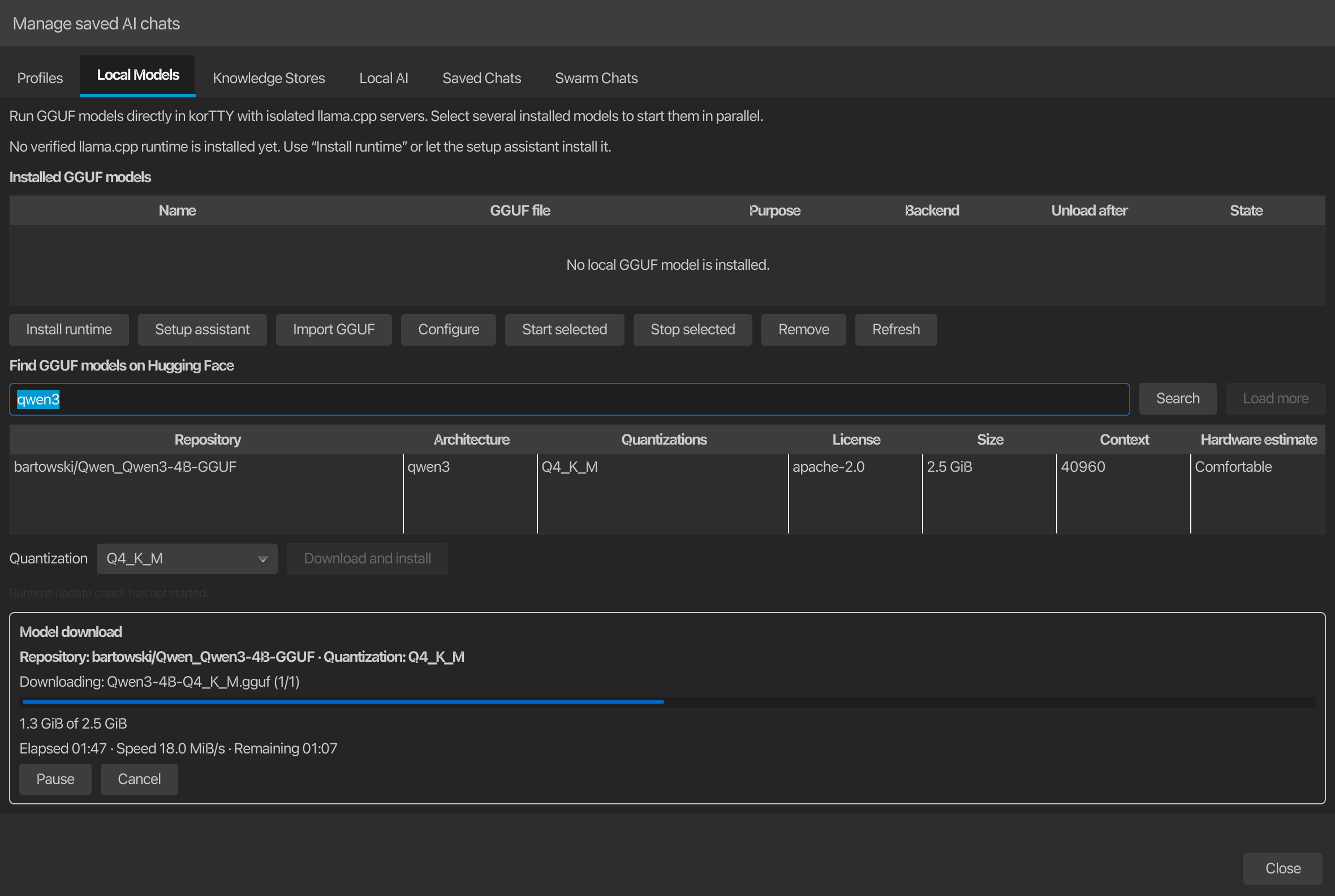
The AI Manager is a modeless window: you can keep it open while you continue working in the main window. Invoking AI Manager again restores and focuses the same manager for that main window instead of opening a duplicate. Its active primary section remains marked by a bold accent underline after focus moves into the section's controls.
The manager combines profile, local-inference, retrieval, and saved-chat management:
- Profiles - Create, edit, test, save, and remove AI profiles. The profile list shows the current quota/usage status for each profile.
- Local Models - Search Hugging Face, import/download/configure GGUF files, run the post-install function test, and start or stop several llama.cpp sidecars.
- Local AI - Assign Text/translation, Coding and session journal profiles, choose the embedding model and preferred runtime backend, store an encrypted Hugging Face token, and select the runtime-update policy.
- Knowledge Stores - Create local HNSW stores, add reviewed files or recursive folders, synchronize sources, and run a test search.
- Saved Chats - Open, rename, refresh, or delete previously saved AI conversations. Saved AI Swarm conversations appear in their own Swarm Chats section, including those produced by scheduled swarm jobs.
Use Settings > AI for global behavior switches and AI Manager for day-to-day profile, model, knowledge-store, and chat management.
Ask the manual (AI docs search)
The built-in manual (Help > Manual, F1) includes an AI-powered search. Toggle AI search in the manual window's toolbar to open a side panel, type a question in natural language — for example "How do I run the AI agent in the terminal window?" — and press Enter.
How it works:
- korTTY selects the most relevant sections from the bundled offline manual (no embeddings, no external search service) and sends only those excerpts together with your question to your default AI profile.
- The answer is generated exclusively from the manual content and is written in the app language. If the manual does not cover the question, the assistant says so instead of guessing.
- Answers cite their sources: click an inline citation or an entry in the Sources list to jump the manual view directly to the referenced page and section.
- If nothing in the manual matches the question, korTTY answers locally without contacting the AI endpoint at all.
Requirements:
- A configured AI profile (see Setup); the default profile is used.
- An unlocked master-password vault when the profile stores an encrypted API key.
Data Security
The question text and the selected manual excerpts are transmitted to the configured AI endpoint. The manual content itself is public documentation, but your question is free text — avoid pasting secrets into it, or use a trusted local endpoint such as LM Studio. Internet access modes are always disabled for manual questions.
AI Agent and AI Planning
korTTY supports agent-style workflows for an active terminal session.
SSH and local shells
The agent's command-execution engine is decoupled from SSH behind an AgentCommandRunner abstraction with two backends — SSH (exec channel) and local (a fresh local process). The AI Agent and AI Planning therefore run both in SSH sessions and in local shells on Windows, macOS and Linux: commands use a native local backend (PowerShell via -EncodedCommand, cmd.exe, or POSIX /bin/sh), the environment probe and system prompt are platform-aware so the model generates native commands, and the same approval flow applies. A local run captures the interactive shell's current directory once and uses it for the probe and every command. Local-shell limitation: no sudo/administrator elevation on Windows. The JobScheduler's headless AI-agent action stays SSH-only.
Starting the agent
- AI Agent - Start from Tools > AI Agent..., from the terminal right-click menu, or with the terminal shortcut command. The agent can open in a dedicated chat tab or target the active terminal window, depending on Settings > AI.
- AI Planning - Start from Tools > AI Planning..., from the terminal right-click menu, or with
agent-plan/agent -plan. Planning mode asks clarifying questions, proposes one or more options, creates a final plan report, and lets you start the accepted plan.
Activity panel and placement
- Split-local activity panel - Terminal-targeted runs appear at the bottom of the terminal split where the run was started. Each split has its own panel, so different splits can run their own agent tasks in parallel.
- Panel placement - Use View > AI Agent Panel to choose At Bottom (default), Dock Left, or Dock Right. Docked mode shows the activity in a resizable side panel attached to the main window; drag its divider to resize. The placement and width are remembered across restarts. In side mode there is one outer tab per terminal of the active terminal tab, and runs are stacked vertically. Switching to another terminal tab swaps the dock to that tab's terminals.
- Agent status indicators - A per-terminal AI-agent status icon appears in the Dashboard tree and prefixed to the terminal's tab title:
- ✋ awaiting input
- ⚡ working
- ⏸ paused
- ✓ finished
- Concurrent runs - Multiple concurrent runs per split are shown as closable tabs in the activity panel (one tab per run), with a per-widget concurrency cap of 5 runs. Finished runs stay as tabs until closed.
- Typing while running - Typing is no longer locked while a run is active. You can continue typing in the shell prompt and launch another
agent ...command (it opens a new concurrent tab). Only run-control keys are intercepted: ++Esc++ or ++Ctrl+C++ cancel the selected tab's run; ++Ctrl+R++ toggles that run's thinking details. - Pause and Resume - Each run tab shows pause and cancel buttons. Pause parks the agent at a safe point between steps; paused time is excluded from the run work-time.
- Current directory - Terminal shortcut runs use korTTY's tracked current directory for SSH and local shells. A local run captures one stable directory for its probe and every command, so commands and generated files remain relative to where the interactive shell was working when the run began.
- Approvals and sudo - The agent can request explicit approval before command execution and can ask for a sudo password in the activity panel. Password input is masked, can be submitted with ++Enter++, and allows up to three wrong-password retries. If a password is cached, it is used only for the current agent/session context. When user input (sudo password / command approval) is required, the panel auto-expands.
- Collapsed status bar - When the panel is collapsed, it shows a compact status bar with the run prompt, state, pause/cancel buttons, and an expand button. A spinner appears while the agent is actively working, and a bold ✋ marker signals when user input is required.
- Keep collapsed - Use Keep collapsed to make the panel start minimized to the status bar.
- Terminal output - Final terminal-agent answers are written back to the terminal area so the shell transcript contains the answer.
- Panel controls - Use the reload button to run the selected agent command again. Copy or snippet actions are available on activity rows. Export the current run or full history as Markdown, plain text, YAML, XML, JSON, PDF, or Asciidoctor. Use Expand all to keep activity details open. Use A- and A+ to change the activity font size. Drag the resize handle to change the panel height.
Terminal agent shortcut commands
When terminal agent shortcuts are enabled and the terminal is at a shell prompt, korTTY intercepts these commands locally instead of sending them to the server:
The base command name is configurable in Settings > AI. If you rename agent, korTTY derives the matching -ask and -plan commands automatically. The same settings page can make the command name case-insensitive and can disable the per-run setup dialog; when the dialog is disabled, korTTY uses the configured default profile.
TAB completion and prompt history
At the shell prompt, TAB completion is enhanced for agent commands:
- Type the agent command name (e.g.,
agent) then press ++TAB++ to offer the command variants (agent,agent-ask,agent-plan). - Type the command plus a space (e.g.,
agent) then press ++TAB++ to offer the recent agent-prompt history. Each row shows the prompt and the date/time it was last run, de-duplicated by prompt text (newest first). - Each history row shows the prompt on the left and the date/time it was last run on the right. Prompts longer than 60 characters are shortened with an ellipsis; the full prompt is still inserted when the entry is selected.
- The history popup is resizable — drag the grip in the bottom-right corner — and remembers its size across restarts. It shows a vertical scrollbar when the history is longer than the popup.
- In the history popup, remove a single prompt by clicking the row's ✕ button (or pressing ++Del++ on keyboards with a forward-delete key), or remove the entire history with Clear all (a two-step confirm guards against accidental wipes). Deletions are saved immediately.
- Outside this context, ++TAB++ is normal shell completion.
History size is configurable in Settings > AI (default 20, range 5–100).
How the AI Agent works
The Terminal AI Agent is a controlled terminal automation workflow. It does not run arbitrary model output directly in the interactive terminal. Instead, each turn follows this pattern:
- korTTY probes the active SSH or local-shell session with a non-interactive command and records compact context such as current user, host, operating system, active terminal working directory, sudo availability, disk path, and recent command state.
- korTTY sends the user task, probe snapshot, previous command results, active AI Skills, and optionally web-tool availability to the selected AI profile.
- The model must return a strict JSON decision: run commands, ask for confirmation, finish, or block.
- korTTY validates the JSON schema and command constraints. Invalid responses are repaired once; unsafe or unsupported command decisions are rejected.
- korTTY runs approved commands through the active backend: SSH exec channels for SSH sessions or fresh local processes for local shells. Each command starts in the directory captured for the run. A
cdinside one command does not persist to the next command. - Command output is added to the activity panel and to the next model turn until the task is complete, blocked, canceled, or the turn limit is reached.
Suitable tasks
The agent is suitable for:
- inspecting files, directories, package state, logs, service state, and system configuration;
- creating or modifying scripts and configuration files when the task asks for it;
- running tests, syntax checks, linters, or read-only diagnostic commands;
- summarizing command output and explaining findings;
- planning multi-step operational changes before implementation.
The agent is not intended for:
- interactive full-screen programs such as
vim,nano,top,less,ssh, or commands that wait for prompts; - long-running daemons or commands without clear completion;
- secret exfiltration or blind destructive commands;
- web research for local files unless you explicitly ask for external/current information.
Example commands
agent show the 10 largest XML files in this directory
agent update groesste_xml.pl so the -r flag searches subdirectories recursively
agent check why nginx failed to start and suggest the safest fix
agent-ask what user and directory am I currently using?
agent-plan migrate this host from package X to package Y
For local file review tasks, name the file in the task. The agent should then inspect it with shell commands such as sed -n, cat, file, or language-specific syntax checks. If an internet-enabled profile is active, korTTY still keeps web tools away from these local file planning prompts unless your task clearly asks for current or external information.
Activity row icons
Activity rows use semantic emoji icons to indicate the action type:
| Icon | Meaning |
|---|---|
| 💾 | Request or input: write/create file |
| 📖 | Action: read file/directory |
| ▶️ | Action: run/execute command |
| 📁 | Action: directory operation |
| 📦 | Context: package manager |
| ⚙️ | Context: service or system |
| 🌐 | Action: network operation |
| 🔍 | Action: inspect/analyze |
| 💭 | State: thinking/reasoning |
| 💬 | Output: message or result |
| ✋ | Required: awaiting user input (sudo/approval) |
| ❌ | State: error or failed activity |
| 🚫 | State: cancelled activity |
Red styling is reserved for error and failed states.
Safety and failure handling
korTTY adds guardrails around agent execution:
- Commands are limited per turn and must be non-interactive.
- Commands that change the system or require privilege can be routed through confirmation depending on settings and model decision.
- Sudo uses
sudo -nand activity-panel password prompts. korTTY does not allowsudo -S,su, or commands that wait indefinitely for a terminal password prompt. - SSH directories are tracked from shell hooks, terminal prompt context, and probe results; if a tracked remote directory no longer exists, korTTY retries the probe from the SSH default directory and reports the issue. Local runs refresh the shell process directory or use an absolute native prompt path, freeze the result for the run, and stop safely when a changed directory cannot be determined or mapped.
- While a terminal-targeted run is active, normal typing is still allowed; only run-control keys (++Esc++/++Ctrl+C++ to cancel the selected run, ++Ctrl+R++ to toggle its thinking details) are intercepted.
- Web-search failures, HTTP errors, authentication errors, empty results, and timeouts are surfaced as explicit tool errors.
- If the AI response does not match the required JSON schema, korTTY asks for a repair. If repair also fails, the run is blocked with an explanation.
AI Swarm (multi-server)
The AI Swarm broadcasts one AI-agent task to many servers at once: each selected server gets its own agent run — including servers without an open terminal — and the per-server answers are combined into a single comparison table. The swarm tab adds an animated per-agent status strip, expandable live transcripts, pause/resume/restart/stop controls per agent and swarm-wide, AI-free script execution from the Snippet Manager, and a Schedule… button that turns the run into an unattended JobScheduler job. Open it with AI > AI Swarm... or Ctrl+Alt+S (Cmd on macOS); see the AI Swarm page for the full feature set.
Generate Workflow Script
After a finished agent run completes successfully, a Workflow button turns the run into a single self-contained, reproducible script in a chosen language (Bash, Python, Perl, Ruby, PowerShell, Ansible playbook, Windows-CMD batch, or AppleScript) with robust error handling, detailed comments, and a header (script name, creator, date/time).
Script generation:
- Auto-loads matching AI Skills (e.g., a language-quality skill for the target language).
- Can produce several language variants and multiple suggestions as inline tabs.
- Supports header templates from the fixed non-deletable Script-Header snippet category.
- Optionally includes a Mermaid flowchart for the script logic. A working spinner is shown while the diagram is generated, so it is clear the AI connection is busy.
- Saves into the Snippet Manager with a short auto-generated name plus correct extension (de-duplicated by full name including extension).
- Tags the snippet as
workflowfor easy filtering. - Auto-sets the System (OS) column from the agent's probed OS (any Linux distro becomes Linux).
- Internet access is forced OFF during generation.
Target languages: Bash, Python, Perl, Ruby, PowerShell, Ansible, plus Windows-CMD (.cmd batch — @echo off lead line, REM header comments, errorlevel checks) and AppleScript (.applescript — osascript shebang, -- comments, try/on error handling).
Each generated-script editor has A− / A+ buttons and supports Ctrl + mouse wheel (Cmd on macOS) to change the font size; the chosen size is remembered across sessions.
The workflow dialog is resizable and remembers its size and position for future use.
Clearer AI backend errors
When the AI server runs out of memory or hits a resource limit (e.g. LM Studio/MLX "Resource limit exceeded", "metal::malloc"), the dialog shows a short, actionable hint instead of the raw multi-line backend stack trace; all other AI errors are collapsed to a single line.